


Shirvan National Park: How 77 Gazelles Became Thousands, and Why You Drive There Yourself

In 1961, a count across the entire Shirvan plain found 77 goitered gazelles. Not thousands — seventy-seven animals, the remnant of a population that had been hunted almost to nothing. Today Shirvan National Park holds several thousand, making this one of the few conservation stories in the region that worked exactly as intended. You can see the result 100–130 kilometres from Baku — and you can drive into the park in your own car to do it.
Remarkably little has been written about this place, even though it is effectively the closest spot to the capital where wild ungulates move in herds through their natural habitat rather than behind a fence.
Where it is and how long the drive actually takes
The park sits across the Salyan and Neftchala districts, near the village of Yenikend. The route from Baku runs south toward Alat and then across flat semi-desert plain.
Honestly about the distance: you’ll sometimes see the phrase “an hour from Baku,” but that isn’t accurate. The real distance is 90 to 130 kilometres depending on your starting point and which entrance you use, and the drive takes between an hour and a half and two hours. Plan your day accordingly, especially if you want to be there at dawn.
There’s no direct public transport: you’d take a bus to Alat and a taxi from there, which costs more and takes longer than simply driving.
The history that gives the place its scale
The numbers here speak for themselves, and they’re unusually persuasive.
1961 — 77 gazelles remain on the plain. A first protected area of roughly 4,930 hectares is created.
1969 — the population recovers to 400. On 30 April, the Shirvan State Reserve is established across 17,700 hectares.
1986 — around 4,800 gazelles.
5 July 2003 — presidential decree No. 1298 converts the reserve into Shirvan National Park, covering 54,373.5 hectares.
Today — estimates range from six to nine thousand animals within the park itself. The spread reflects different counting methods and survey years, but nobody disputes the order of magnitude.
And one figure that often gets overlooked: gazelles from Shirvan are being resettled into areas where the species had vanished. Hundreds have been moved to Absheron and Ag-Gel National Parks, the Ajinohur steppe, the Ilisu and Korchay reserves, and Vashlovani National Park in Georgia. This isn’t just a population — it’s a donor herd being used to restore the species across the region.
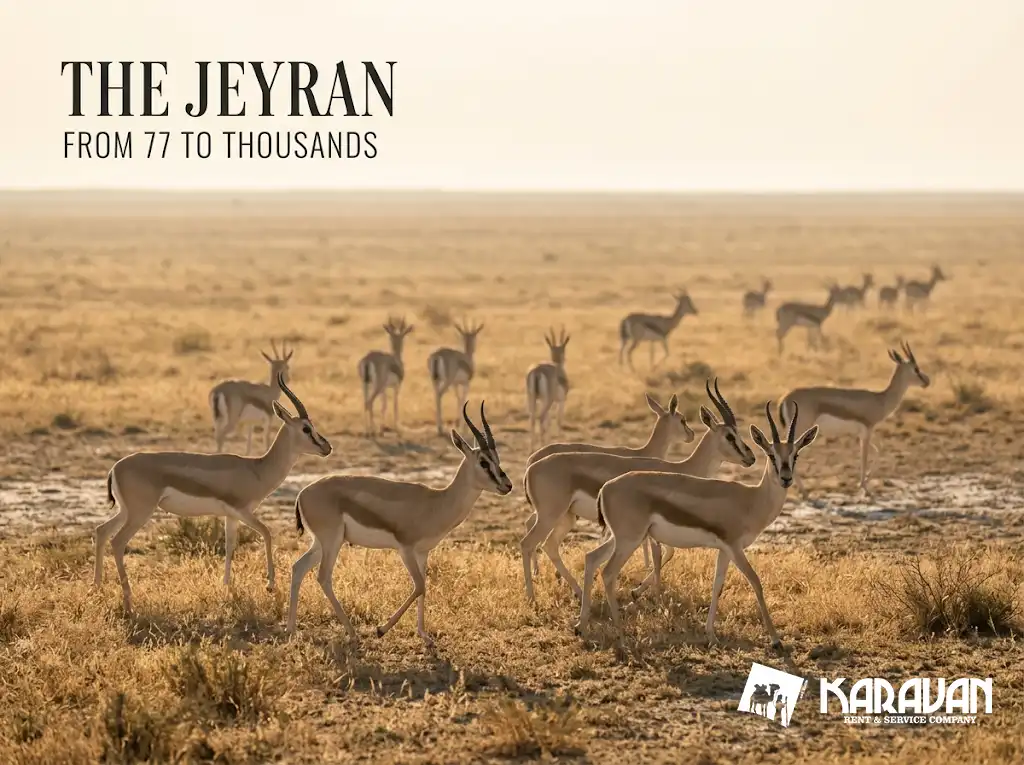
What’s actually out there
The landscape is unfamiliar to anyone arriving from Baku. This is the semi-desert of the Kura-Araz lowland, lying 20 to 25 metres below sea level. There are no rivers or springs inside the park at all — the gazelles’ water comes from Lake Chala (Qizilqaz), the Shirvan collector, and the Caspian shoreline.
One detail explains why the species survived here specifically: a goitered gazelle can drink water containing 9 to 14 grams of salt per litre. Above that, it becomes lethal. The animal is effectively adapted to water most ungulates couldn’t touch.
What else you might see. The park holds around 30 mammal species: jungle cat, wild boar, wolf, fox, badger. There are 22 reptile species — 3 tortoises, 6 lizards, and 8 snakes — plus 4 amphibians and 35 fish species.
Birds are a reason to come in their own right. More than 200 species, of which roughly 32 to 34 are rare or threatened. You’ll find flamingo, black francolin, great bustard, little bustard, purple swamphen, white-tailed eagle, steppe and imperial eagles, peregrine falcon and saker falcon. The Greater and Lesser Chala lakes are 60–65% covered in reeds and rushes — that’s the main nesting and wintering ground.
Why people drive here in their own car
This isn’t a marketing argument — it’s how the place works.
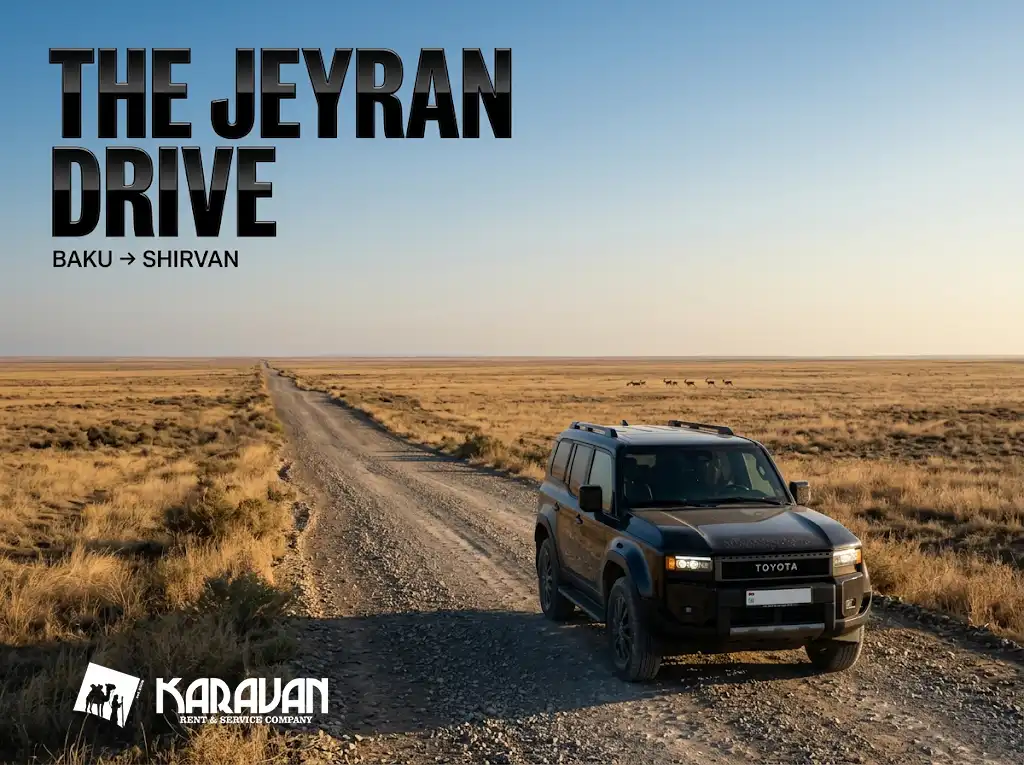
You can drive into the park. You pay at the entrance and then move around the territory in your own vehicle. It is, in effect, a self-drive safari. That’s also how the gazelles are best observed: the animals keep their distance, and a car acts as a mobile hide they tolerate far better than a person on foot.
Gazelles are watched at dawn. The best observation window is early morning, which means leaving Baku in the dark, around five. No tour coach runs on that schedule, and no scheduled transport will get you there by sunrise. Your own car is the only way to be in place at the right hour.
The distances inside are substantial too. The territory runs to more than 54,000 hectares, and moving between observation points, lakes and dunes on foot isn’t realistic.
On the roads. A proper highway takes you to the park, but surfaces change inside the semi-desert, and off-season rain can soften the ground. A sedan manages in dry weather, but a crossover with higher clearance gives you noticeably more freedom, especially if you want to reach the further points. We covered which models suit these routes in our guide to Toyota SUVs at Karavan Rent A Car in Baku.
When to go: two windows few people know about
For gazelles — autumn. Observations show herding behaviour is seasonal: in summer the animals scatter into small groups, in spring they gather more tightly, and in autumn the herding index runs 9 to 10 times higher than in other seasons. Average herd size is 15 to 17 animals. Put simply, your odds of seeing a proper herd rather than two silhouettes on the horizon are several times better in autumn.
For birds — spring and autumn, during migration. That’s when species concentration on the lakes peaks.
Summer is hard going. Semi-desert, no shade, and daytime heat that drains people and animals alike — gazelles are barely active then. If you go in summer, go at dawn and carry plenty of water.
In winter the park is quieter, but the gazelles don’t leave: they shift from the north-eastern quarters to the more sheltered south-western areas.
The practical part
Entry. A national park ticket costs 2 manat per person — the same for Azerbaijani citizens and foreigners.
Cash. As almost everywhere outside Baku, don’t count on cards. Withdraw manat in advance — we covered this in detail in our piece on where in the regions only cash is accepted.
What to bring. Binoculars or a zoom lens — without optics, distant gazelles are just dots. Plenty of water, a hat, closed shoes. Bring food too: there’s minimal infrastructure inside.
Contacting the park. The administration can be reached on +994 55 900 53 52 and at shirvanmp@gmail.com. It’s worth confirming opening hours and entry conditions in advance, particularly if you’re arriving very early or with a group.
What to combine it with. The southbound route passes Gobustan, so the trip folds naturally into one long day or an overnight loop.
FAQ
How long is the drive to Shirvan National Park from Baku?
Between 90 and 130 kilometres depending on the route, and an hour and a half to two hours by car. The “one hour from Baku” phrasing you sometimes see is not accurate.
Can I drive my own car into the park?
Yes. You pay at the entrance and move around the territory by car — that’s the main format, since distances inside are large and the animals tolerate a vehicle far better than a pedestrian.
How much does entry to Shirvan National Park cost?
2 manat per person, the same for local and foreign visitors.
What time of day is best for seeing gazelles?
Early morning. During the day, especially in summer, the animals are barely active. Leave Baku before sunrise.
Which season gives the best chance of seeing a large herd?
Autumn: the herding index is 9 to 10 times higher than in spring and summer. Average herd size is 15 to 17 animals.
How many gazelles are in the park now?
Estimates across sources range from six to nine thousand. For comparison: in 1961 there were 77 animals left across the entire plain.
Do I need an SUV?
In dry weather a sedan handles the main routes. But a crossover with higher clearance gives more freedom on unpaved sections, particularly off-season.
Can I get there by public transport?
In theory yes — a bus to Alat and then a taxi — but it takes longer and costs more than driving, and it won’t get you there by dawn.
Conclusion
Shirvan is a rare case of a genuinely protected semi-desert with a restored Red Book population sitting close to a capital city, rather than a decorative picnic zone. The story of seventy-seven gazelles becoming a donor herd for half the region deserves to be seen in person.
The one condition is having your own car: to arrive at dawn, to move around inside the park, and not to depend on somebody else’s timetable.
If you’re planning that trip, message Karavan Rent A Car in Baku’s official chat on WhatsApp or Telegram: +994-55-455-22-45. We’ll match a car to the route and flag what to expect on the road toward Salyan.
- Where in Azerbaijan’s regions only cash is accepted: read the article
- The tourist markup at Yashil Bazaar: read the article
- Toyota SUVs at Karavan Rent A Car: read the article